

Hazard Analysis & Critical Control Points
HACCP Certification Consultancy
Strengthen your organization with HACCP based food safety controls that help prevent contamination, improve process monitoring, enhance consumer confidence, and support consistent compliance across your food supply chain
What is HACCP Certification?
HACCP stands for Hazard Analysis and Critical Control Points. It is a preventive food safety system used to identify, evaluate, and control hazards that may affect food safety during food processing, handling, storage, packaging, distribution, and service.
A HACCP system helps food businesses control biological, chemical, physical, and allergen related hazards through monitoring, corrective actions, verification, and proper documentation. HACCP certification is often required by buyers, retailers, exporters, hotels, restaurants, and food supply chain partners.
HACCP can also support ISO 22000 certification, GMP certification, and other food safety management system requirements
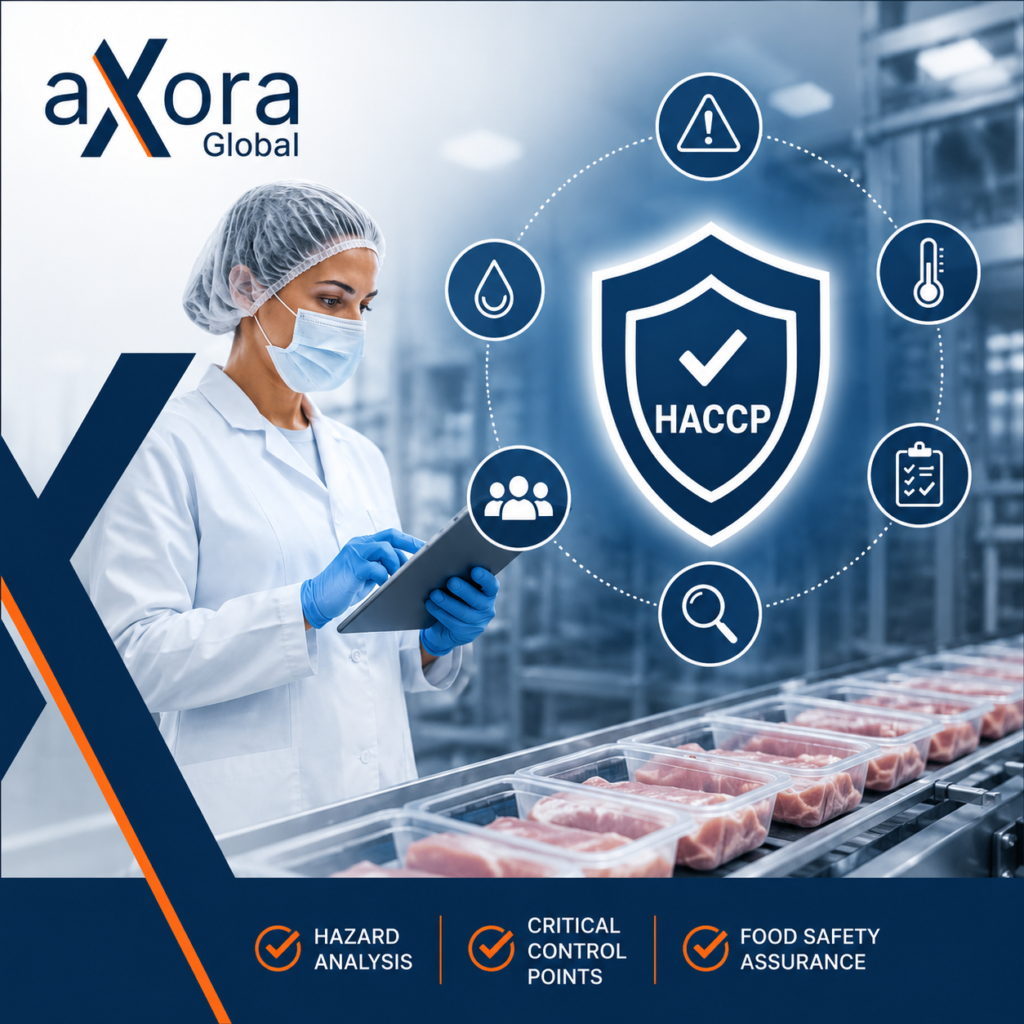
Why HACCP Certification Matters
Why HACCP Certification Matters
Food safety is a critical requirement for every organization involved in the food chain. A properly implemented HACCP system helps businesses prevent contamination, protect consumers, improve process control, and meet customer, buyer, or audit expectations.
Here’s why HACCP certification is important for every food-related organization:
1. Consumer Safety & Trust
HACCP helps identify and control food safety hazards before they reach the consumer, reducing contamination risks and strengthening customer confidence.
2. Preventive Food Safety Control
HACCP focuses on prevention rather than only final product inspection. It helps businesses control hazards at critical stages of receiving, processing, storage, packaging, and distribution.
3. Buyer & Supplier Approval
Many buyers, retailers, hotels, restaurants, exporters, and supply chain partners require HACCP-based food safety controls before approving a supplier or vendor.
4. Better Process Monitoring
By defining critical control points, limits, monitoring methods, and corrective actions, HACCP helps organizations improve control over daily food operations.
5. Risk Reduction
The system supports proactive identification and control of biological, chemical, physical, and allergen-related hazards, reducing the risk of foodborne incidents, complaints, and recalls.
6. Enhanced Brand Reputation
Organizations with a properly implemented HACCP system are trusted by customers, buyers, distributors, and audit bodies, strengthening credibility and long-term business relationships

Key Principles of HACCP
HACCP is built on seven essential principles that form the foundation of a preventive food safety control system:
1. Conduct Hazard Analysis
Identify and evaluate potential biological, chemical, physical, and allergen-related hazards at each stage of the food process.
2. Determine Critical Control Points
Identify the points in the process where control is essential to prevent, eliminate, or reduce food safety hazards to an acceptable level.
3. Establish Critical Limits
Set measurable limits for each critical control point, such as temperature, time, pH, moisture level, metal detection, or other safety criteria.
4. Establish Monitoring Procedures
Define how each critical control point will be monitored, who will monitor it, how often monitoring will be done, and what records will be maintained.
5. Establish Corrective Actions
Define clear actions to be taken when monitoring shows that a critical limit has not been met or a process is not under control.
6. Establish Verification Procedures
Review records, conduct inspections, perform testing, and complete internal audits to confirm that the HACCP system is working effectively.
7. Establish Documentation and Records
Maintain proper HACCP plans, hazard analysis records, monitoring forms, corrective action records, verification records, and supporting food safety documents.
Core HACCP Implementation Areas
HACCP is structured around a practical food safety control process that focuses on hazard identification, critical control points, monitoring, corrective action, verification, and records.
- • Product and Process Understanding: Defining product details, intended use, ingredients, processing steps, storage conditions, and distribution methods.
• Process Flow Diagram: Mapping the complete food process from receiving to processing, packaging, storage, and dispatch.
• Hazard Analysis: Identifying biological, chemical, physical, and allergen-related hazards at each process step.
• Critical Control Points: Determining where control is essential to prevent, eliminate, or reduce food safety hazards.
• Critical Limits: Setting measurable limits such as time, temperature, pH, moisture level, or detection criteria.
• Monitoring Procedures: Establishing how CCPs will be monitored, who will monitor them, and what records will be maintained.
• Corrective Actions: Defining actions to take when a critical limit is exceeded or a process is not under control.
• Verification and Validation: Confirming that the HACCP system is effective through reviews, testing, inspections, and internal audits.
• Documentation and Records: Maintaining HACCP plans, monitoring records, corrective action reports, verification evidence, and supporting procedures.
These implementation areas help food businesses maintain safe handling from procurement to processing, packaging, storage, distribution, and service.
Benefits of HACCP Certification
Implementing HACCP with professional consultancy support leads to practical improvements in food safety control, audit readiness, and business credibility.
Operational Benefits
• Reduced food contamination and foodborne illness risks
• Improved control of critical points in the food process
• Better hygiene, sanitation, storage, and handling practices
• Clear monitoring, corrective action, and verification records
• Stronger traceability and recall readiness
• Better integration with ISO 22000, GMP, Halal, and other food safety systems
Financial Benefits
• Lower risk of product rejection, recalls, and customer complaints
• Reduced waste caused by poor handling or uncontrolled processes
• Improved resource use through better process discipline
• Stronger eligibility for supplier approval, vendor registration, and buyer audits
• Better readiness for food export and large-scale distribution requirements
Reputational Benefits
• Increased customer and buyer confidence
• Competitive advantage in food manufacturing, catering, retail, and export markets
• Stronger credibility with auditors, distributors, and business partners
• Improved trust through documented food safety controls
• Better brand protection against food safety incidents
HACCP certification consultancy is not just about documentation. It helps your organization build a preventive food safety culture that protects consumers, strengthens compliance, and improves business performance.
The HACCP Certification Process with Axora Global
At Axora Global, we ensure a smooth and practical HACCP implementation journey through expert guidance, customized documentation, staff training, and certification audit readiness support.
Step 1: Initial Consultation & Gap Analysis
We assess your current food safety practices, documentation, hygiene controls, process flow, prerequisite programs, and HACCP readiness to identify gaps.
Step 2: HACCP Plan & Documentation
Our consultants develop HACCP documents tailored to your operation, including hazard analysis, CCP identification, critical limits, monitoring forms, corrective action records, SOPs, and supporting food safety procedures.
Step 3: Implementation & Employee Training
We train your team on HACCP principles, hazard control, hygiene practices, food handling, CCP monitoring, corrective actions, verification, and recordkeeping.
Step 4: Internal Audit & Verification
Our consultants support internal audit and verification activities to confirm that the HACCP system is properly implemented and ready for customer, buyer, or third-party audit requirements.
Step 5: Certification Audit Coordination
We coordinate with independent certification or audit bodies where applicable and support your organization through the external audit process until the certification decision is completed by the certification body.
Step 6: Post-Certification Maintenance
We assist with surveillance audits, HACCP plan updates, documentation maintenance, refresher training, corrective actions, and integration with ISO 22000, GMP, Halal, and other food safety systems.

Documentation Provided by Axora Global
When you work with Axora Global, you receive customized HACCP documentation templates based on your food process, product type, facility practices, and audit requirements, including:
• HACCP Manual or HACCP Overview
• Food Safety Policy
• Product Description and Intended Use
• Process Flow Diagrams
• Hazard Analysis Reports
• CCP Identification and Decision Tree
• HACCP Plan
• Critical Limit Records
• CCP Monitoring Records
• Corrective Action Records
• Verification and Validation Records
• Cleaning and Sanitation Procedures
• Personal Hygiene Procedures
• Supplier Approval and Evaluation Forms
• Traceability and Recall Procedure
• Internal Audit Checklists
• Training Records and Awareness Forms
Why Choose Axora Global for HACCP Certification?
At Axora Global, we are not just consultants, we are your food safety and compliance partners.
Food Safety Expertise:
Experienced HACCP consultants with practical knowledge of hazard analysis, CCP monitoring, hygiene controls, prerequisite programs, and food industry audit requirements.
Tailored Solutions:
Every HACCP system is developed around your organization’s actual food processes, product risks, facility layout, and customer or audit requirements.
Practical Implementation:
Our approach focuses on real food safety controls, helping your team apply HACCP requirements in daily operations instead of only maintaining paperwork.
Third-Party Certification Support:
We support coordination with independent certification or audit bodies where applicable, helping your organization become ready for external HACCP audits.
Affordable Packages:
Cost-effective HACCP consultancy solutions suitable for SMEs, food manufacturers, restaurants, hotels, catering businesses, exporters, and large enterprises.
Ongoing Support:
We assist with HACCP plan updates, surveillance audit preparation, documentation maintenance, refresher training, corrective actions, and continual improvement.
We help organizations achieve global recognition through ISO certification and compliance excellence.
From initial consultation to final certification, Axora Global ensures your business meets international standards efficiently and affordably.