

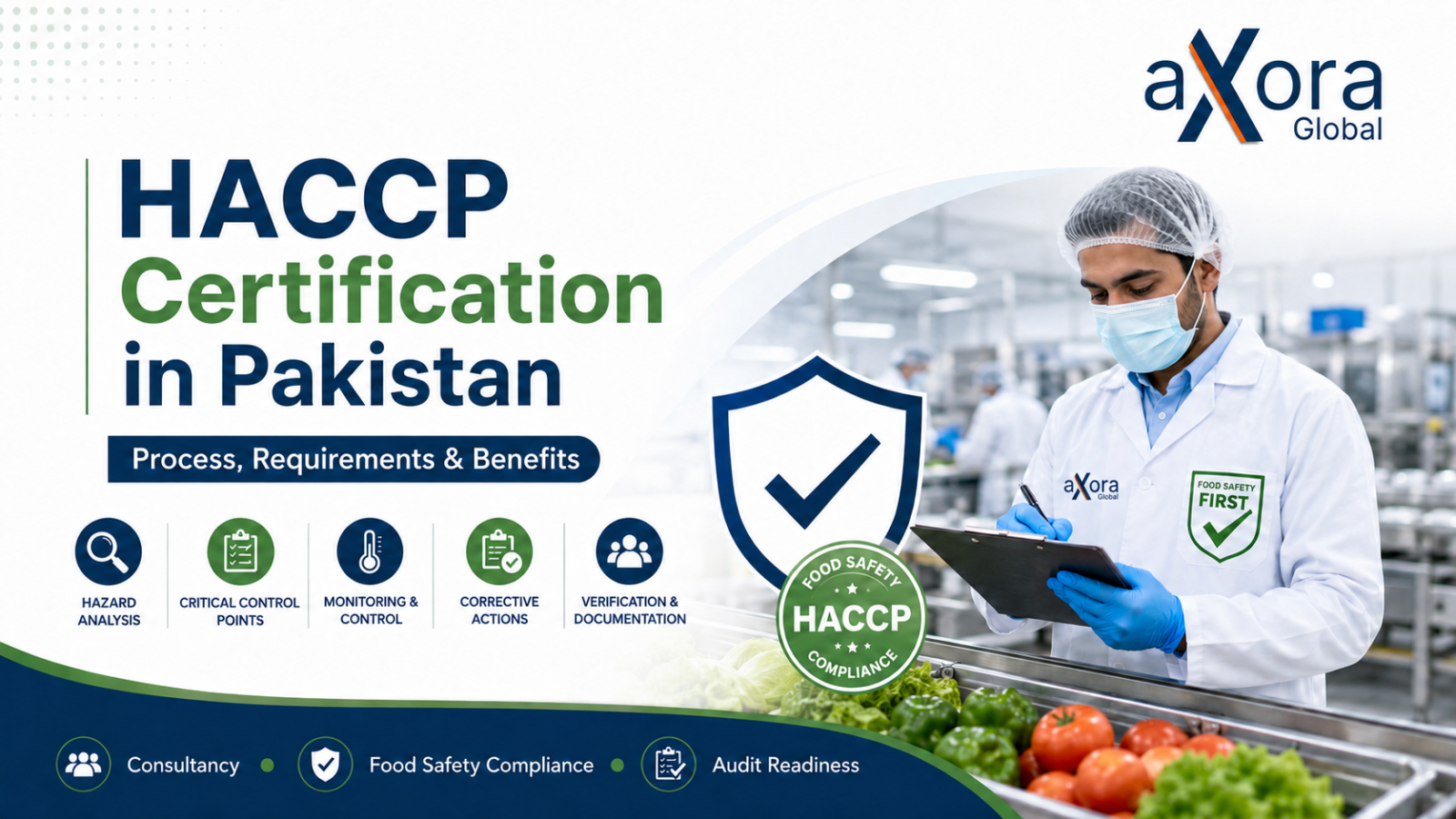
Food safety is a major responsibility for every food business. Whether you are involved in food manufacturing, processing, packaging, storage, catering, restaurants, distribution, or export, you must control food safety hazards before they reach the consumer.
HACCP certification in Pakistan helps food businesses build a preventive food safety system based on hazard analysis, critical control points, monitoring, corrective actions, and proper documentation.
For growing food businesses, HACCP is not only about certification. It helps improve hygiene, reduce contamination risks, meet buyer expectations, and prepare for food safety audits.
Axora Global provides ISO certification and compliance consultancy services to help businesses implement practical food safety systems and prepare for third-party certification audits.
What Is HACCP?
HACCP stands for Hazard Analysis and Critical Control Points. It is a food safety system used to identify, evaluate, and control hazards that may affect food safety.
These hazards may include:
- Biological hazards: bacteria, viruses, molds, and other microorganisms
- Chemical hazards: cleaning chemicals, allergens, pesticide residues, or food additives
- Physical hazards: glass, metal, plastic, stones, hair, or other foreign materials
The main purpose of HACCP is prevention. Instead of relying only on final product inspection, HACCP controls food safety risks during each stage of the process.
Why HACCP Certification Matters for Food Businesses in Pakistan
Pakistan’s food industry is growing rapidly, and customers, retailers, exporters, and corporate buyers are becoming more serious about food safety compliance. Businesses that cannot show proper food safety controls may face customer complaints, rejected orders, audit failures, or loss of buyer confidence.
HACCP certification can help food businesses:
- Improve food safety control
- Reduce contamination risks
- Strengthen hygiene and sanitation systems
- Improve documentation and traceability
- Meet buyer, supplier, and export expectations
- Prepare for customer and certification audits
- Build a foundation for ISO 22000, FSSC 22000, BRCGS, and GMP systems
HACCP is also closely connected with broader food safety awareness. You can also read our related blog on World Food Safety Day 2026 to understand why safer food systems matter for businesses and consumers.
The 7 Principles of HACCP
HACCP is based on seven internationally recognized principles:
- Conduct hazard analysis
- Determine critical control points
- Establish critical limits
- Establish monitoring procedures
- Establish corrective actions
- Establish verification procedures
- Maintain documentation and records
These principles help food businesses identify where food safety hazards may occur and how those hazards should be controlled, monitored, and verified.
HACCP Certification Process in Pakistan
The HACCP certification process depends on the size, process complexity, and current readiness of the business. However, most organizations follow these key steps:
1. Food Safety Gap Analysis
The current system is reviewed to identify gaps in hygiene, sanitation, pest control, temperature monitoring, supplier approval, traceability, documentation, and employee training.
2. HACCP Team Formation
A HACCP team is formed with people who understand production, quality, storage, maintenance, and food safety risks.
3. Product and Process Review
The business prepares product descriptions, intended use, process flow diagrams, and process step verification.
4. Hazard Analysis and CCP Identification
Food safety hazards are identified at each process step. Critical Control Points are selected where control is necessary to prevent or reduce food safety risks.
5. Documentation and Implementation
The HACCP plan, monitoring records, corrective action forms, sanitation procedures, and verification records are prepared and implemented in daily operations.
6. Training and Awareness
Employees are trained on hygiene, contamination control, CCP monitoring, recordkeeping, and corrective actions.
7. Internal Audit and Audit Readiness
An internal audit is conducted to confirm that the HACCP system is implemented properly before the third-party certification audit.
Documents Required for HACCP Certification
Proper documentation is important because it provides evidence that food safety controls are being followed. Common HACCP documents include:
- Food safety policy
- HACCP team details
- Product description
- Process flow diagram
- Hazard analysis worksheet
- CCP monitoring records
- Critical limits and corrective actions
- Cleaning and sanitation records
- Pest control records
- Supplier approval records
- Training records
- Traceability and recall records
- Internal audit reports
- Management review records
The documentation should match the actual process of the business. A copied or generic HACCP plan can create problems during implementation and audit.
Benefits of HACCP Certification
HACCP certification provides practical benefits for food businesses that want stronger food safety control and better market credibility.
- Better food safety: Hazards are identified and controlled before they affect consumers.
- Improved customer trust: Buyers and customers gain confidence in the company’s food safety system.
- Reduced contamination risks: Critical process points are monitored and controlled.
- Stronger audit readiness: Records, procedures, and controls are organized for inspections and audits.
- Support for export growth: HACCP can help meet buyer and international market expectations.
- Foundation for advanced standards: HACCP supports future implementation of ISO 22000, FSSC 22000, BRCGS, and GMP.
HACCP vs ISO 22000: What Is the Difference?
HACCP focuses on identifying and controlling food safety hazards through critical control points. ISO 22000 is a complete food safety management system that includes HACCP principles along with management system requirements such as leadership, communication, objectives, internal audits, corrective actions, and continual improvement.
In simple words:
- HACCP focuses on food safety hazard control.
- ISO 22000 provides a complete food safety management system built around HACCP principles.
Many businesses start with HACCP and later upgrade to ISO 22000 or FSSC 22000 depending on customer, buyer, or export requirements.
How Axora Global Supports HACCP Certification Preparation
Axora Global provides consultancy support to help food businesses develop, implement, and improve HACCP systems. Our focus is to make the system practical, documented, and audit-ready.
Our HACCP consultancy support may include:
- Food safety gap analysis
- HACCP plan development
- Process flow diagram preparation
- Hazard analysis and CCP identification
- Food safety documentation
- Hygiene and sanitation procedure development
- Employee awareness training
- Traceability and recall preparation
- Internal audit support
- Corrective action guidance
- Third-party certification audit readiness
Axora Global supports businesses in preparing for third-party, IAF-accredited certification through recognized certification bodies. Axora Global does not issue certificates directly. Our role is to help organizations build effective systems and prepare confidently for external audits.
Final Thoughts
HACCP certification is an important step for food businesses that want to improve food safety, reduce contamination risks, strengthen documentation, and build customer confidence.
For food businesses in Pakistan, HACCP can support compliance, buyer approval, export readiness, and long-term food safety performance.
Need HACCP certification support in Pakistan? Contact Axora Global for HACCP consultancy, documentation, employee training, internal audits, and third-party certification audit readiness.
FAQs About HACCP Certification in Pakistan
What is HACCP certification?
HACCP certification confirms that a food business has implemented a food safety system to identify, control, monitor, and verify food safety hazards.
Which businesses need HACCP?
HACCP is useful for food manufacturers, restaurants, caterers, hotels, dairy processors, meat processors, bakeries, beverage companies, packaging companies, cold storage providers, and food exporters.
What documents are required for HACCP certification?
Common documents include a HACCP plan, hazard analysis, CCP monitoring records, corrective action records, cleaning records, pest control records, training records, supplier approval records, traceability records, and internal audit reports.
What is the difference between HACCP and ISO 22000?
HACCP focuses on hazard control, while ISO 22000 is a complete food safety management system that includes HACCP principles and management system requirements.
Can Axora Global issue HACCP certificates?
No. Axora Global does not issue certificates directly. We provide consultancy, implementation, documentation, training, internal audit, and audit readiness support for third-party certification through recognized certification bodies.
Add a Comment