

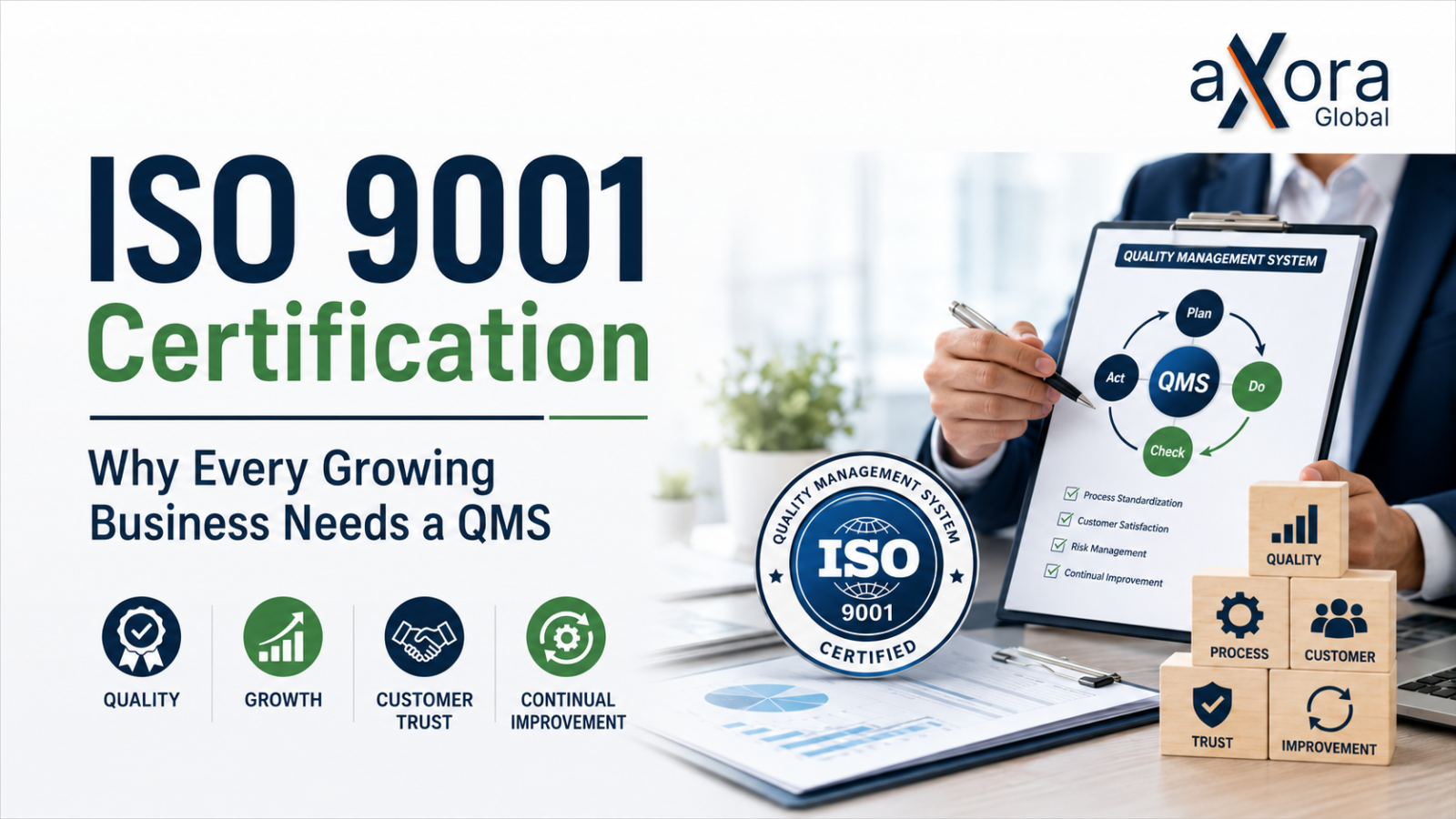
This is where ISO 9001 certification becomes valuable.
Update, 16 September 2026: ISO has published a new edition of the standard. See what changed in ISO 9001:2026 and how to transition. Existing ISO 9001:2015 certificates stay valid during the transition period. If you are planning the paperwork, our ISO 9001 documents list sets out the 4 documents and 18 records the standard actually asks for.
ISO 9001 is the internationally recognized standard for Quality Management Systems, commonly known as a QMS. It helps businesses create structured processes, improve consistency, reduce errors, and deliver better products or services.
For growing businesses in Pakistan, ISO 9001 certification is not only about getting a certificate. It is about building a stronger, more reliable, and more scalable business system.
What Is ISO 9001 Certification?
ISO 9001 certification confirms that a business has implemented a quality management system that meets the requirements of the ISO 9001 standard. This system helps an organization manage quality across its operations, from customer communication and purchasing to production, service delivery, complaint handling, documentation, and improvement.
The standard can be used by organizations of any size and across many sectors, including manufacturing, services, healthcare, education, construction, technology, government, and non-profit organizations.
In simple words, ISO 9001 helps a business answer important questions:
- Are our processes clearly defined?
- Do our employees know their responsibilities?
- Are we meeting customer requirements consistently?
- Are we tracking complaints, errors, delays, and improvements?
- Do we have records to prove our performance?
- Are we improving over time?
A business that cannot answer these questions clearly may struggle as it grows.
What Is a Quality Management System?
A Quality Management System, or QMS, is a structured way of managing how a business delivers quality. It includes policies, procedures, responsibilities, records, objectives, risk controls, audits, and improvement activities.
A QMS does not mean unnecessary paperwork. A good QMS makes work easier by creating clarity.
It helps teams understand:
- What needs to be done
- Who is responsible
- How the work should be performed
- What records must be maintained
- How problems should be reported
- How improvements should be made
For a growing business, this structure is essential. Without it, operations often depend too much on individuals instead of systems. When key employees are absent, when orders increase, or when customers demand proof of compliance, the business may face avoidable problems.
Why Growing Businesses Need ISO 9001
Many businesses start with informal systems. In the early stage, the owner or senior manager may personally check everything. But as the business grows, this approach becomes difficult.
A growing company needs systems that can work even when the owner is not involved in every decision.
ISO 9001 helps growing businesses create this system.
1. It Improves Process Control
One of the biggest benefits of ISO 9001 certification is better process control. The standard encourages businesses to define, monitor, and improve their processes.
This means the business can reduce confusion, duplication, delays, and inconsistent work methods.
For example, if a company receives customer orders through phone calls, WhatsApp, emails, and sales staff, mistakes can happen easily. A QMS helps standardize how orders are received, confirmed, processed, delivered, and recorded.
This improves reliability and customer satisfaction.
2. It Builds Customer Trust
Customers want confidence. They want to know that a supplier can deliver consistently, handle complaints professionally, and meet agreed requirements.
For many businesses, especially those dealing with corporate clients, exporters, government tenders, or multinational companies, ISO 9001 certification can improve credibility. It shows that the organization has taken quality seriously and has implemented a recognized management system.
This can be especially useful for businesses in:
- Manufacturing
- Packaging
- Food and beverage
- Construction
- Logistics
- Engineering
- Healthcare
- IT and software services
- Professional services
- Trading and distribution
3. It Reduces Errors and Rework
Μistakes are costly. They waste time, damage customer trust, increase complaints, and reduce profitability.
A QMS helps businesses identify where errors happen and why they happen. Instead of only fixing the immediate problem, ISO 9001 encourages corrective action, root cause analysis, and continual improvement.
This means the business learns from mistakes and prevents them from happening again.
For example, if a customer receives the wrong product, the solution is not only to replace the product. A strong QMS investigates the cause. Was the order recorded incorrectly? Was the product labeling unclear? Was the dispatch checklist missing? Was the employee not trained?
By finding the root cause, the business can prevent repeat issues.
4. It Supports Business Growth
Growth without systems can create pressure. Teams become overloaded, managers lose visibility, and customers begin to experience inconsistent service.
ISO 9001 supports growth by creating a foundation for scalability.
It helps businesses:
- Standardize key operations
- Train new employees faster
- Monitor performance
- Reduce dependency on individuals
- Improve communication between departments
- Handle more customers with better control
- Prepare for bigger clients and audits
A business with a strong QMS is better prepared to expand because it has documented systems, trained staff, measurable objectives, and improvement controls.
5. It Helps Meet Tender and Client Requirements
Many corporate clients, government departments, and large buyers prefer or require ISO-certified suppliers. In some cases, ISO 9001 certification can support eligibility for tenders, vendor registration, and supply chain approval.
Even when certification is not mandatory, it can give a business a competitive advantage.
It shows that the company is serious about quality, documentation, customer satisfaction, and process improvement.
For businesses in Pakistan that want to work with larger organizations or international buyers, ISO 9001 can support stronger market positioning.
6. It Improves Internal Communication
As companies grow, communication problems become common. Sales may promise something that production cannot deliver. Procurement may purchase materials without proper specifications. Customer complaints may not reach management. Employees may follow different methods for the same task.
ISO 9001 helps improve internal communication by defining roles, responsibilities, processes, records, and reporting channels.
This creates better coordination between departments.
When everyone understands the process, work becomes smoother and more predictable.
7. It Encourages Risk-Based Thinking
ISO 9001 includes the concept of risk-based thinking. This means businesses should identify risks that may affect quality and take action before problems occur.
Examples of business risks include:
- Supplier delays
- Poor raw material quality
- Lack of employee training
- Equipment breakdown
- Customer complaint trends
- Documentation errors
- Inconsistent inspection methods
- Poor communication between teams
By identifying risks early, businesses can take preventive action. This helps reduce disruptions and improve customer confidence.
8. It Creates a Culture of Continual Improvement
A growing business should not only work harder. It should work smarter.
ISO 9001 promotes continual improvement by encouraging businesses to review performance, analyze data, conduct internal audits, manage corrective actions, and improve processes over time.
This helps the company move from reactive management to proactive improvement.
Instead of waiting for customers to complain, the business starts identifying weaknesses and improving them before they become serious problems.
Key Requirements of ISO 9001
ISO 9001 is based on a structured management system. While every business is different, the standard generally focuses on the following areas:
1. Context of the Organization
The business must understand its internal and external issues, interested parties, customer needs, and the scope of the QMS.
2. Leadership
Top management must show commitment to quality, customer satisfaction, objectives, roles, responsibilities, and continual improvement.
3. Planning
The company must identify risks, opportunities, quality objectives, and actions needed to achieve them.
4. Support
This includes resources, employee competence, awareness, communication, and documented information.
5. Operation
The organization must control its operational processes, customer requirements, purchasing, production, service delivery, and nonconforming outputs.
6. Performance Evaluation
The company must monitor performance, customer satisfaction, internal audits, and management review.
7. Improvement
The business must manage nonconformities, corrective actions, and continual improvement.
Documents Commonly Needed for ISO 9001 Certification
The required documentation depends on the size and nature of the business, but common QMS documents may include:
- Quality policy
- Quality objectives
- Scope of the QMS
- Process flow charts
- Risk and opportunity assessment
- Standard operating procedures
- Job descriptions and responsibility matrix
- Customer complaint records
- Supplier evaluation records
- Inspection and testing records
- Training records
- Internal audit reports
- Corrective action reports
- Management review meeting minutes
A well-prepared QMS should be practical. The goal is not to create unnecessary files. The goal is to create useful documents that help the business operate better.
ISO 9001 Certification Process
The ISO 9001 certification process usually includes the following steps.
Step 1: Initial Gap Analysis
A consultant or internal team reviews the current system and compares it with ISO 9001 requirements. This helps identify missing documents, weak processes, training needs, and improvement areas.
Step 2: QMS Documentation
The business prepares the required policies, procedures, forms, records, and process controls.
Step 3: Implementation
The documented system is applied in daily operations. Employees begin following the defined procedures and maintaining required records.
Step 4: Training and Awareness
Employees are trained on ISO 9001 requirements, quality responsibilities, documentation, risk controls, and process ownership.
Step 5: Internal Audit
An internal audit checks whether the system is properly implemented and whether it meets ISO 9001 requirements.
Step 6: Corrective Actions
Any gaps or nonconformities found during the internal audit are corrected before the external audit.
Step 7: Management Review
Top management reviews QMS performance, audit results, customer feedback, objectives, risks, and improvement actions.
Step 8: External Certification Audit
An independent certification body audits the organization. If the system meets the requirements, ISO 9001 certification is issued.
Common Mistakes Businesses Make During ISO 9001 Implementation
Many businesses face problems during ISO 9001 implementation because they treat certification as a paperwork exercise.
Here are some common mistakes to avoid:
1. Creating Documents That Employees Do Not Use
Documents should match real business operations. If procedures are written only for the auditor and not for the team, the system will fail in practice.
2. Lack of Management Involvement
ISO 9001 requires leadership commitment. If top management is not involved, employees may not take the system seriously.
3. Poor Employee Training
Employees must understand their roles. Without training, even good procedures may not be followed correctly.
4. Ignoring Customer Complaints
Customer feedback is an important part of quality improvement. Complaints should be recorded, reviewed, and used for corrective action.
5. Weak Internal Audits
Internal audits should identify real improvement opportunities. They should not be treated as a formality.
6. No Follow-Up on Corrective Actions
Finding a problem is not enough. The business must take action, verify effectiveness, and prevent recurrence.
Which Businesses Should Consider ISO 9001?
ISO 9001 is useful for almost any organization that wants better process control, customer satisfaction, and business credibility.
It is especially valuable for:
- Manufacturers
- Service providers
- Exporters
- Contractors
- Engineering companies
- Food and packaging businesses
- Healthcare organizations
- Educational institutions
- Logistics companies
- IT and software companies
- Trading businesses
- SMEs preparing for growth
- Companies applying for tenders
If your business is growing and your current systems are becoming difficult to manage, ISO 9001 can help create structure.
ISO 9001 and Business Performance
ISO 9001 is often seen as a compliance standard, but its real value is business improvement.
A strong QMS can help improve:
- Customer satisfaction
- Employee accountability
- Process efficiency
- Supplier performance
- Product or service consistency
- Complaint handling
- Data-based decision-making
- Audit readiness
- Management control
For growing businesses, these benefits can directly support stronger operations and better market reputation.
How Axora Global Helps Businesses with ISO 9001 Certification
Axora Global helps businesses develop, implement, and improve quality management systems according to ISO 9001 requirements.
Our support may include:
- ISO 9001 gap analysis
- QMS documentation
- Process mapping
- Risk and opportunity assessment
- Quality policy and objectives development
- Employee awareness training
- Internal audit support
- Corrective action guidance
- Management review preparation
- External audit readiness support
The goal is not only to help your business achieve ISO 9001 certification. The goal is to help you build a practical quality management system that supports long-term growth, customer trust, and operational improvement.
Final Thoughts
Every growing business reaches a stage where informal systems are no longer enough. To grow sustainably, a company needs clear processes, trained employees, reliable records, strong leadership, and a culture of improvement.
ISO 9001 certification provides that structure.
It helps businesses improve quality, reduce errors, satisfy customers, and prepare for bigger opportunities. Whether your company is in manufacturing, services, logistics, construction, food, healthcare, or technology, ISO 9001 can help you build a stronger foundation for growth.
Need ISO 9001 certification support in Pakistan? Contact Axora Global for expert QMS consultancy, documentation, training, and audit preparation.
FAQs About ISO 9001 Certification
What is ISO 9001 certification?
ISO 9001 certification confirms that an organization has implemented a quality management system that meets the requirements of the ISO 9001 standard.
What is a QMS?
A QMS, or Quality Management System, is a structured system of policies, processes, records, responsibilities, and improvement activities used to manage quality.
Is ISO 9001 only for manufacturing companies?
No. ISO 9001 can be used by organizations of any size and sector, including services, healthcare, education, construction, logistics, technology, and government organizations.
How long does ISO 9001 certification take?
The timeline depends on the size of the organization, current documentation, process complexity, and readiness level. Small businesses may complete implementation faster, while larger or multi-site organizations may need more time.
Why does a growing business need ISO 9001?
A growing business needs ISO 9001 because it helps standardize processes, reduce mistakes, improve customer satisfaction, train employees, and prepare for larger clients or tenders.
Does ISO 9001 improve customer trust?
Yes. ISO 9001 can improve customer trust by showing that the business has a structured quality management system and is committed to consistent performance and continual improvement.
Can Axora Global help with ISO 9001 certification?
Yes. Axora Global can support businesses with gap analysis, QMS documentation, implementation, training, internal audits, corrective actions, and certification audit preparation.